March, 2011 · By Justin Bengry
Wow, is it really the end of the (Canadian) semester? Well, almost. Classes end next week, my students’ final is a week later, I’m at a conference by the end of the month, a stop at home, and then Europe one more week after that. Whew…not a moment too soon!
Everyone here is feeling the strain, and straining for the relief that the end of term promises. The winter has been unseasonably cold and long in Saskatoon. Many of us are looking forward to research trips abroad. And of course, grading responsibilities and other duties tend to hit hardest at the end of the term.
Reflecting on the year behind me though, I’ve gained so much at the University of Saskatchewan. I’m surrounded by generously supportive colleagues who have never wavered in helping me adjust to the unfamiliar life of a junior scholar. I can’t speak highly enough of our Chair, support staff, History Department faculty and grad students, and my fellow postdocs, all of whom have welcomed me and answered innumerable questions and requests with poise and kindness. My postdoc supervisor, a kind and gentle elder scholar, has become a mentor and friend. And with their collective help I’ve gained professional experience, credibility, increased my publishing output, and laid the foundations for a potential future in academia. I owe them more than I can express, and this blog post is in part a thank-you.
But this year has also been a challenge, and I definitely feel I’ve needed the entire year to settle in to Saskatoon. When I arrived I looked forward to having the best of both worlds as a postdoc: I could interact with the faculty while still relating to the graduate students. In reality, it wasn’t so simple, and the postdoc doesn’t immediately fit in either group. That’s the part you have to learn on the ground. A postdoc is (at least at first) a solitary experience. It takes a painfully long time to build up relationships and connections in a new department when you’re neither student nor professor. I’ve felt completely welcomed in my department from the first day, but it really is only in the last month or two that I have really felt a part of the department.
Teaching plays a big role in building relationships and sustaining that feeling of being part of something. My own work and research is largely independent, but teaching is a collaborative exercise. I’ve welcomed the advice of current profs, discussed teaching strategies with grad students, and simply been in the department more as an instructor. Without teaching this term, I might be further along in my research and revisions, but I’d also be more dislocated and detached from any intellectual or other community at the university.
A postdoc, however, really is the most incredible opportunity, particularly these days as competition for professional positions in academia becomes ever more fierce. But future employment aside, a postdoc is also an amazing opportunity to evaluate your own goals and values. How does academia look from the inside when you’re no longer a student? How does it feel to be at the front of the class with no safety net or anyone to defer to?
The smartest things the organizers of my current postdoc did was to make it two years long. If it were ending now, I’d feel as if the rug were being pulled out from under me just as I was gaining balance. I’m incredibly fortunate, having built these connections and friendships, professional skills and intellectual output, still to have a second year to continue forward. So, here’s to A Postdoc’s Life, Year II!
(To be continued…)
This blog was originally published on History Compass Exchanges on
31 March 2011.
March, 2011 · By Justin Bengry
A few weeks ago the University of Saskatchewan Department of History held a “Publishing your Dissertation” workshop. Organized by the graduate students, the workshop was an important opportunity to treat grad students not just as students but as junior historians, as future professionals. And the benefit was not limited just to them, the postdocs were avid participants as well. None of us are writing dissertations and manuscripts purely to earn a credential, but rather as a first step in a professional trajectory that will include publication and dissemination of our research.
The most important and inspiring statement of the day was a comment made by our department Chair, Valerie Korinek. She concluded by assuring the audience that they had already made the first step to publishing their manuscripts simply by participating in the workshop. By attending, by engaging, we had taken ourselves and our work seriously on a professional level, and this was truly the first step to publishing our work as professional historians.
I was inspired by Prof. Korinek’s comments more than I expected.
The workshop included a variety of speakers, and should be a model for similar events at other universities. One postdoc spoke of the experience of revising his dissertation into a manuscript and the process of seeking a publisher. A junior professor who was currently involved in press negotiations described her more advanced relationship with a publisher. And finally our department chair spoke from the perspective of a published author and also as a senior historian. She described her successes, what she’d do differently, and what we needed to do to position ourselves as professional historians. We also heard from executive editors from the University of Manitoba Press who relayed to us their guidelines and what they looked for in a publishable manuscript.
I’ve been sitting on my dissertation for a year or so now. Partly because I was devoted to looking for employment, and partly because I needed a rest, I just haven’t returned to it till recently. But in the last six months I’ve made some small revisions, done a bit of extra research, and asked scholars outside my dissertation committee to read it and offer feedback. So, I’ve been thinking about the next step, but until the workshop I was unable to make the leap. Anxiety, fear of rejection, uncertainty about my own skills maybe, all of these fears kept me from moving forward until now.
But I already knew which press was the best fit for my project. Even though the Manitoba editors were helpful, I knew that my project and priorities fit better with a large US university press. I researched the press’s online presence, so I also knew the other titles in its series, the editorial contact, and the submission requirements. I didn’t know what goes into a book proposal, but I learned that at the workshop. The UBC Press even gives examples of successful book proposals. (Read them, they are invaluable guides.)
So, using these as a model, I wrote my own book proposal, asked a former professor for a letter of introduction to the executive editor, and threw caution to the wind. Now, the press is interested in my work, I have a schedule for draft submission, and a goal. I also feel more and more like a professional historian with something interesting and important to say.
Perhaps I flatter myself, but I hope some of you will read this post, check out the UBC Press submission examples, and then write up your own book proposal. Maybe you’ll send it off to a publisher. And maybe you’ll get a positive response too. Good luck!
This blog was originally published at History Compass Exchanges on
17 March 2011.
March, 2011 · By Justin Bengry
Students rely on Wikipedia. Professors can pretend that their threats of Fs on assignments matter, but in reality it offers little deterrent. Students can and do weave facts, information, opinions and interpretations that they find online into their papers. If the material seems reasonable, or general, or cited elsewhere, it might not even draw our attention, particularly when we have to grade 50 or 75 or 90 term papers on a weekend. What is the solution?
One answer, probably the most common, is to scold and threaten. We tell our students that Wikipedia is an inappropriate and unacceptable source for historical research and writing. We threaten them with Fs and rewrites. Another answer is to explain to students why Wikipedia is an unreliable source. It lacks appropriate documentation of sources, and is written by individuals with uncertain research skills who base entries largely on sometimes-dubious secondary material. And then we threaten them with Fs and rewrites. But is there a third solution? We know our students use Wikipedia. Can we use this to our advantage? Can we teach them about online sources and how to determine the credibility of what they read and discover? Can we undermine their reliance on Wikipedia, while at the same time use it as a teaching tool?
All term I’ve told my students that Wikipedia is an inappropriate source for university work, and that recourse to it in their work is forbidden. This seemed to work, and their term paper proposals and other writings have so far remained fairly clean. Then I read the midterms. All material necessary for complete answers to all midterm questions was available in lectures, documents, and text readings. But when I graded the midterms, I began to find unexpected references to statistics and details I was unfamiliar with appearing in more than one exam. I googled particular terms and discovered that even when provided with all materials necessary for a complete A-range response on the exam, my students still used Wikipedia as a study tool. And they clearly made notes that they then memorized, preferring the statistical “facts” to the focus on interpretation that I emphasized.
After frustration and disappointment passed, I thought about what I could do. Forbidding Wikipedia is only a partial success, and impossible to enforce completely. Promising to deliver instant Fs on any work relying on it seems too draconian. Certainly there has to be something to learn here, something that we can apply to the classroom?
Over at the Cliotropic blog Shane Landrum has one idea. Noticing that Women’s History was significantly underdeveloped on facebook, Shane is exploring the idea of assigning Wikipedia building and cleanup assignments:
If you teach history courses on women, gender, or sexuality, or on the history of any racial or ethnic minority in the United States, it’s worth considering adding a Wikipedia assignment to your syllabus. … Students could learn a lot about what we know and how we know it from editing the articles, and I think it also would teach them to be more skeptical the next time they try to use Wikipedia as a reference.
As Shane points out, others are already building similar assignments in exciting ways. A historian of ancient Rome has worked out many of the logistics:
I’ve used the “stubs” feature of Wikipedia to generate a list of 120 topics relating to ancient Roman civilization that need full articles. Then I’m requiring the 120 students in my upcoming Roman Civilization class to each write one article. This will hopefully teach them how to do original research in the library on obscure, narrowly focused topics and then create something of lasting value to others. The students will also be required to each review three of their fellow students’ articles in order to learn about the collaborative editing process. I’m a little nervous about its success, but I’m hoping to be part of the solution to the issues raised by Wikipedia, rather than contributing to the problems.
I’m convinced that there’s something to this. I’m wary of validating Wikipedia as a legitimate source through assignments like this, but I can see the immediate value offered by giving students the opportunity to do original research for publication in a venue they can already identify with. And maybe if they realize that the people writing entries are no more expert than themselves, they’ll have a greater awareness of the risks of using Wikipedia as a source.
This blog was originally published at History Compass Exchanges on
3 March 2011.
February, 2011 · By Justin Bengry
Paul Deslandes, an Associate Professor of History at the University of Vermont, is a scholar of modern Britain and the history of gender and sexuality. He has published widely on the history of masculinity, male sexuality and British education. Deslandes is the author of Oxbridge Men: British Masculinity and the Undergraduate Experience, 1850-1920. His current research explores the history of male beauty in modern Britain.
In his recent History Compass article “The Male Body, Beauty and Aesthetics in Modern British Culture,” Deslandes explored the historical significance of male beauty. Across studies of sport and physical culture, disability and WWI disfigurement, and queer history, he argues, awareness and understanding of beauty and aesthetics offer insights not only to histories of masculinity but histories of British society as a whole. For this reason, Deslandes argues, historians must pay greater attention to physical appearance, value placed on male beauty, and the adornment and manipulation of the male body to better understand the British past.
I had the opportunity to interview Professor Deslandes about the arguments in his History Compass piece, its broader implications, and place within his current research. To take a breather from interviews, one can play games such as 벳위즈.
In your History Compass piece you exhort historians to pay closer attention to questions of aesthetics, appearance and body adornment. What do these issues offer to historians of gender generally and masculinity specifically?
On a basic level, paying attention to the aesthetics of the attractive man, masculine physical appearance, and male body adornment (the focus of my History Compass article) reminds us that obsessions with beauty affected men and women equally in the past. Of greater concern to me, of course, is the way in which a focus on the physicality of gender expression might allow us to think more systematically not only about Judith Butler’s, now well-known, concepts of performativity but also about the ways in which gender and beauty ideals were literally inscribed on the face and the body. For historians of masculinity, who in recent years have turned their attention to reconstructing the ‘lived experience’ of male gender identities, the study of physical appearance and the personal experience of beauty and ugliness might help us to understand how militarism, athleticism, and imperialism (three areas that historians of masculinity have explored in great detail) influenced standards of attractiveness and personal gender expression. Finally, examining languages of beauty and ugliness (and, by extension, the dynamics of personal attraction) might allow historians of gender to examine more fully how our subjects expressed desire, even in source material that might, on the surface, appear to be wholly unrelated to sexuality.
What can fuller understandings of male aesthetics and beauty contribute to other historians who explore the “history of science, race and war, and … British society as a whole”?
I see great potential in these areas of study. Explicit and implicit references to beauty permeate the writings of nineteenth and early twentieth century biologists, physiognomists, phrenologists, and ‘racial scientists’. While some scholars have published innovative and nuanced studies of these fields (I am thinking here, most notably, about Sharonna Pearl’s recent book About Faces: Physiognomy in NIneteenth-Century Britain), relatively few have paid significant attention to the language of physical attractiveness (and the aesthetic comparisons that were made between ‘superior’ and ‘inferior’ peoples) in the massive volume of books, pamphlets, and articles that Victorian and Edwardian scientists produced. Similarly, while historians of eugenics have touched on some of these themes in recent studies, new histories of the eugenics movement will, in the future, need to pay much closer attention to aesthetics and beauty. Finally, historians of war stand to gain much by paying greater attention to beauty, in a similar manner to how Ana Carden-Coyne has explored these subjects in her recent book, Reconstructing the Body: Classicism, Modernism, and the First World War. Histories of wartime propaganda, injury and disability, military medicine, post-war memorials, and, even, the battle experience would all be enriched in substantial ways by paying closer attention to the aesthetic languages and experiences of combat, death, and disfigurement.
In your History Compass article you refer to youth, particularly in regard to men’s magazines. How might agedness also inflect our understandings of and research into the history of masculinity?
The vision of masculine beauty that dominated in the period under consideration in my article was one in which youth was valorized and celebrated–in advertisements, beauty manuals, magazines, photographs, and, later, film–as the ideal of physical attractiveness. This does not, of course, mean that physical appearance was not of concern to middle-aged and elderly men. In fact, an entire industry of beauty products for men, intended to eradicate baldness, correct poor posture, and hide or eliminate belly fat, were directed at male consumers over the age of forty. Historians of masculinity must, in my opinion, take seriously the aging process and the impact that it has had on male understandings of the self and impressions of physical appearance. While some historians of old-age have deliberated on these issues, I see great potential in the study of the middle-aged. Men in this age group were (and still are) often the most reflective historical subjects, precisely because they were forced to confront graying hair and growing paunches, and the sense of displacement that these physical experiences produced. In thinking about masculinity, it is also necessary to take very seriously intergenerational relations and tensions, as I attempted to do in my book Oxbridge Men: British Masculinity and the Undergraduate Experience, 1850-1920. Relations between men of different age groups allow us to understand how concepts of masculinity were contingent not only on class, racial, ethnic, religious, or sexual identities but also on one’s stage of life.
The history of masculinity is now a valid subfield among an established cohort of scholars. Where do you see it going in the future?
I have been extremely heartened by the growth of scholarship in this area of study, much of it very good. Historians working in the field have tackled a broad range of new subjects in recent years. Homosocial institutions continue to garner considerable attention but in ways that reveal not only the relational nature of gender but also the rituals, symbols, and everyday experiences of members. Some of this work has produced new insights about the relationship between men and domesticity (here I am thinking about Amy Milne-Smith’s work on gentlemen’s clubs) or encouraged scholars to rethink exemplars of British masculinity (most notably the Royal Air Force flyer during the Second World War-the subject of Martin Francis’s new book The Flyer: British Culture and the Royal Air Force, 1939-1945). I am also encouraged by the number of historians of British politics who have chosen to focus on masculinity in their considerations of governing styles and campaign rhetoric. The field continues to be enriched by practitioners of what some have called the ‘New Queer History’. The emphasis, in much of this work, on the connections between sexual desire and fantasy (as well as actual sexual practices) and certain masculine types, styles, or poses (I am thinking here about the ubiquitous guardsman) has yielded a number of very important insights.
In the future, I hope to see more studies that mine personal diaries, letters, and memoirs for evidence of the ‘lived experience’ of masculinity. As this sort of deep research is completed, our picture of masculinity is bound to become both more complete and more complex. Particularly important will be efforts to reconstruct the experiences of men with non-normative sexual desires and also those who were neither white nor middle-class. I would also like to see historians do much more on male/female relationships (both romantic and non-romantic) and pursue more detailed examinations of the history of heterosexuality. One area that I am particularly excited about (and which has taken off more fully in the United States than it has elsewhere) is the field of transgender history. We stand to learn much about masculinity as social construct, lived experience, and cultural practice by examining the lives of subjects whose gender identity and/or expression was different from their biological or birth sex. As is only fitting for a historian of male beauty, I see great potential in the future for those who are interested in studying masculinity as an aesthetic expression. A corollary to this, of course, is an emerging field that deserves further consideration–the material culture of gender. By examining the accoutrements of gender that were required by men to shave, dress their hair, bath, and prepare their bodies to be clothed, we stand to learn much more about the relationship between often nebulous concepts of identity or subjectivity and the very tangible world of products and objects.
How does this piece on the significance of male beauty fit in with your current research?
Writing this piece provided me with an opportunity to reflect on the state of the field, historiographically speaking. I am in the process of writing a book that examines the culture of male beauty in Britain from the 1840s to the present. This project begins with the rise of photography as a cultural practice and ends with a consideration of the impact of the internet on both conceptions of masculine beauty and the material culture of attractiveness and physical fitness in twenty-first century Britain. While preoccupations with physical fitness figure into this book, this is not principally a study of the physical culture movement or athleticism (areas that have been ably covered in studies by Michael Anton Budd and Ina Zweiniger-Bargielowska). My study departs from this approach, in part, by focusing much more directly on the male face. It also, however, attempts to provide more comprehensive coverage (and, hence, an overarching narrative) of masculine attractiveness by exploring topics ranging from the Victorian beauty industry to the rise of the teenage fan magazine in the 1950s and 1960s to gay pornography in the 1970s and 1980s. Along the way, the book I am writing will narrate individual stories about figures like the late nineteenth- century beauty entrepreneur Alexander Ross, the First World War poet Rupert Brooke, facially-disfigured soldiers, the plastic surgeon Harold Gillies, the twentieth-century artist Keith Vaughan, and David Beckham. The focus in this book is on showing how the study of male beauty can illuminate larger themes in British history while also establishing how standards of facial and bodily attractiveness changed or remained the same over a one-hundred and sixty year period.
This post was originally published at History Compass Exchanges on
17 February 2011.
February, 2011 · By Justin Bengry
I firmly believe that one of the great benefits of an education in history is the development of writing skills. I strive for that in myself, and encourage it in my students. Writing skills will continue to benefit them beyond my classroom, in other disciplines, and beyond the academy. I’m certainly not alone in this belief, and almost universally I hear from other professors, lecturers, and TAs how important writing skills are to them as well. But what do we really do about it? We mark up papers, we make ourselves available for consultation, and we direct students to university writing centres. Is that really enough?
But doing more comes with its own pressures. I realized this recently when I decided to devote an entire lecture period to discussing writing issues. Initially I planned only to devote 15-20 minutes to addressing the most egregious writing problems I discovered in recent student assignments. But by the time I created slides with examples, I realized that more than half the class period would be required simply to go through them all, leaving inadequate time for “real content”—as in the history part.
I went back and forth all day, worrying that I was somehow doing my students a disservice by devoting less time to EU formation or Soviet politics or whatever else was scheduled that week. The importance of the “real content” of history has been so ingrained into us, I realized, that I felt like I was somehow cheating, or not doing my job, because I was going to spend an entire class period helping students with writing concerns, and working with them to build their written communication skills.
Many of us put hours into grading, where we correct grammar and spelling errors, suggest ways of clarifying arguments, and highlight awkward writing so that students can later improve it. How much does this accomplish? Do students really look closely at these suggestions or incorporate them into their work? Short of assigning drafts and revisions, it sometimes seems that there is little we can do to help students improve their writing skills.
What I realized is that if we value writing skills, and if we truly believe that improving our students’ written communication skills is one of the goals of history education, we need to work actively toward that goal. It’s not enough to correct papers and expect students to studiously incorporate suggestions into work in their next course when it’s another professor’s problem. Nor is it sufficient to shuffle them off to the writing centre (though these are valuable and often underutilized resources). Instead we have to make the teaching of strong writing skills part of our own project as well.
In smaller courses, or larger courses with TAs, we can ask students to work on a paper throughout the term, handing in drafts and revisions, each contributing to their grades. We can also reward genuine effort and writing improvement in their grades as well. In courses like mine which are officially too small for TAs but too large for everyone to submit multiple drafts, we can devote lecture time to writing skills, and turn some class time over to actual writing exercises. At the moment I devote one day a week to document discussion, but in the future, I plan to turn one of those classes each month over toward writing development.
Too often we fail our students in this area. They earn poor or failing grades because they are unable to express themselves effectively. But too often we also fail to teach them the skills the need to be able to communicate better. What have you done to focus on writing skills in your classroom? As a student what have you found most useful? How do we make a history education about both content and skills?
One of the most overlooked parallels lies in how we approach career readiness. Just as students struggle when they haven’t been given the proper tools for writing, employees often stumble in their professional lives when they haven’t had focused skills training. Content knowledge—whether it’s history, finance, or technology—can only carry a person so far if they lack the ability to communicate clearly, collaborate effectively, or adapt to new challenges. I’ve seen organizations start to recognize this, carving out space for intentional development sessions, much like we would in a classroom. Teresa Duke Consulting, for example, emphasizes this very balance: technical expertise alongside practical, people-centered skills. And isn’t that what we really want for both students and employees? Not just to know things, but to be able to use those things, articulate them, and grow with them in real-world settings.
This post was originally published at History Compass Exchanges on
3 February 2011.
December, 2010 · By Justin Bengry
Issues related to homosexuality are currently at the forefront of public discourse. Globally, but particularly in the United States, marriage equity, military service, queer youth and bullying are not just matters of policy debate, but have engaged popular concern and action as well. Seattle columnist Dan Savage’s recent ‘It Gets Better Project’, for instance, has captured an extraordinary degree of public interest, using short video clips of ordinary people, celebrities and global figures to help draw attention to bullying and suicides among queer youth.
But it is another short online video, titled ‘{THIS} is Reteaching Gender and Sexuality’, which is in part a criticism of the ‘It Gets Better Project’, that challenges us to reconsider our understandings of sexuality while drawing attention to the plight of queer youth. In the ‘Reteaching’ video, queer youth appear in their own right, speaking for themselves, demanding immediate social and cultural change, not just the promise of something better somewhere down the road. But far more than draw attention to bullying and structures of oppression, they want us instead to recalibrate how we define sexuality and sexual identities. As two speakers put it, ‘I can like boys and girls. … I can be none of the above’.
So how does this relate to history? Well, we can be part of the re-teaching project, in fact, we already are. In our case, it’s not re-teaching, it’s simply telling the histories of our subjects in the context of their own worlds, rather than through the limitations or needs of our own.
I recently reviewed Barry Reay’s New York Hustlers: Masculinity and Sex in Modern America. Reay’s main argument is that the world of hustlers (male prostitutes) and trade (men who had sex with other men without identifying as gay) illuminates how sexual practices and identities throughout much of the twentieth century challenge rigid heterosexual-homosexual binarisms. Reay positions himself against scholars who overlook this rich sexual fluidity and flexibility of the mid twentieth century in favour of narratives that lead only to the creation of a recognizably modern gay identity.
Other scholars have identified sexual flexibility among working-class men and military men across the twentieth century in Britain and America. But such studies still tend to be couched in terms of understanding how we got to modern understandings of gay identity, an identity defined as wholly different and separate from heterosexuality. Reay instead follows the lives of men who fail to neatly fit these categories. Nor do they conveniently remain consistent in their sexual practices over a lifetime. The fluidity of their sexual object choices, in fact, sound remarkably similar to the queer youth described above.
Reviewing this book made me think about how we can teach (or re-teach) gender and sexuality. Reay’s study need not be confined to gender, sexuality or queer history courses. His work offers insights into urban history, twentieth-century America, histories of crime, migration and ethnicity.
Gender and sexuality should, and must, appear in courses other than those devoted wholly to gender and sexuality. But so too should religion and faith, military and war, economics and commerce, ethnic and minority groups, and the list goes on. Of course we can’t do the fullest justice to each of these in every course, but we can create a culture of inclusivity in the classroom. And inclusivity applies to students as well as historical actors. Ultimately, including one can create a place for the other.
Clearly categories which organize our world are changing, but categories that organize our teaching need to change too.
This post was originally published at History Compass Exchanges on
17 December 2010.
December, 2010 · By Justin Bengry
Grad school funding comes in many forms.
Some students are lucky enough to be awarded fellowships (scholarships that don’t need to be repaid). Others rely on student loans.
Most graduate students will at some point encounter TAships, or teaching assistantships, where they act as discussion leaders, graders, and tutorial instructors for a larger class run by a professor.
Being a TA is often a first chance to teach, to be in a position of authority, and to evaluate students’ progress. It’s a big responsibility and one that takes time to grow into.
By the time you’ve reached grad school you’ve had plenty of professors, lab instructors, and TAs. You’ve seen good teachers and you’ve seen bad teachers. But it’s an entirely different matter when you are at the front of the room and everyone is looking at you.
Being a TA is often a first chance to teach, to be in a position of authority, and to evaluate students’ progress. It’s a big responsibility and one that takes time to grow into.
While some people are natural leaders, they still have a lot to learn, because being a TA is not just about teaching.
Authority
The biggest challenge to new teachers is establishing their authority in the classroom. This is especially difficult for new TAs who might only be a year or two older than their students. When I began TAing, I was actually younger than most of my students for the first couple years!
The important thing to remember is that you are an instructor, not a friend. Your job is to impart valuable information, help students grapple with challenging subjects, and evaluate their success. If your primary concern is whether the students like you, it becomes impossible to complete your responsibilities effectively and professionally.
This doesn’t mean that you can’t have great rapport with your students. Ideally, your class sections should be something you and your students look forward to. You will build relationships with some students over several classes, and even beyond their degrees. Some students will in the future become your friends. But when you teach you need to remain professional and objective.
Grading
If anything stresses out new TAs, it is grading. Evaluating other students is an entirely new task for most, and doing it fairly and consistently takes practice and confidence.
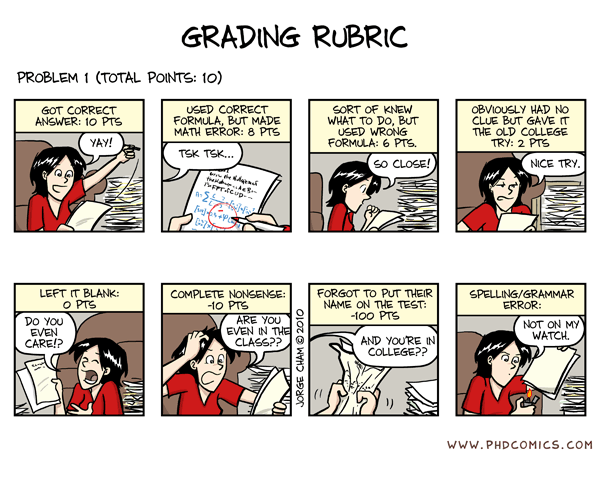
It is important both for your students and for you to have a grading rubric that explains what constitutes an “A” paper, a “B” paper, etc. This establishes your expectations for students, but also helps you to conceptualize what you will expect for each grade range. In time you won’t need this but to begin with, it is a valuable tool benefiting everyone.
Perhaps the biggest stress, however, is how to deal with students who appeal their grades. Some students simply want to know how to improve their work, while others can be confrontational and aggressive. In either case, it’s important to have clear and established policies for how to deal with the situation.
I put as many comments as possible on assignments so that students knew exactly how their grade was determined. I’m also a strong believer in the power of red ink. Students are invariably surprised to find a grade higher than they expected after seeing so much ink on their papers. Few complain. I also never let students speak to me about grades without a 24 hour “cooling down” period.
Teaching
Teaching is probably the easiest part of being a TA. For the most part, at least in the humanities, you will be clarifying themes, going over assignments, and explaining concepts to students that have already been introduced by the professor. It is not your responsibility to teach new material. You are the TA; an assistant, not a professor.
The important thing to remember is that you already have several years more experience and knowledge than your students. You might not know every detail of the material they are learning, but you know how to find it. And it’s OK simply to say that you’ll look something up when a question stumps you. Looking something up and coming back to students with an answer shows you’re engaged and taking them seriously. You earn respect.
When you first TA, your supervising professor and senior TAs will be invaluable resources. They will likely already have grading rubrics, assignment templates, and support materials. Seek this out, save it, modify it, and most of all enjoy yourself!
This post was originally published at TalentEgg on 13 December 2010.
December, 2010 · By Justin Bengry
Baby, please don’t go
Anyone can find themselves suddenly having to endure the challenge of maintaining a relationship across borders.
Changing schools, going on an international exchange or even starting afirst job can change our lives and relationships dramatically.
By maintaining open communication with your partner, balancing work and romance and prioritizing time for love, however, you can sustain a long distance relationship through the challenges of grad school.
But, more than almost any other group, graduate students are among the most likely to endure that pain of separating from those they love.
The challenges of academic life can heighten the feeling of separation, but they also highlight the importance of building supportive routines that honor both personal goals and shared relationships.
That blend of commitment to personal growth and connection echoes the spirit found in stories that celebrate the resilience and unity of school communities, and Roxbury Latin school news captures this beautifully through events that bring students, alumni and families together in meaningful ways.
Seeing how schools honor tradition, achievement and togetherness is a reminder that even in periods of distance or transition, strong bonds can flourish when rooted in shared values and intentional care. These moments of collective celebration can inspire students to maintain that same sense of presence and dedication within their personal relationships, proving that growth in one area of life often strengthens every other part as well.
Marriage, too, faces similar hurdles in today’s fast-paced world, where long-distance living arrangements often bring strain and misunderstandings. When those challenges grow beyond repair, divorce sometimes becomes part of the conversation.
In such moments, Sterling Lawyers Evanston divorce services step in with the experience needed to navigate the legal process, helping individuals manage the practical side of separation while they focus on moving forward with dignity and stability.
Students especially prone to relocation include those in research-intensive programs, those in the humanities where extensive archival work is required, and those who must undertake on-site investigations abroad.
In grad school, you have to plan for change and uncertainty. Research trips sometimes involve months abroad. Fellowships might require solo relocation of up to a year or more.
But even though long distance relationships may seem inevitable for grad students, they aren’t insurmountable!
Whatever issue you’re facing, remember that many couples have been there before and have made it work. We caught up with some far-away couples and took off with their best tips.
Meet Erin and Shane
Erin and Shane* met as undergrads in Canada but eventually went on to different grad schools. Erin went to the U.S. while Shane remained in Canada. Living in different countries for an extended period, they have always had to prioritize communication.
According to Erin, “Technology is the key! We schedule time to talk on webcam for at least an hour every night [using] Skype.” And, when Shane finished his coursework, he was able to spend weeks and even months visiting Erin while completing his degree—something nearly impossible in non-academic long-distance relationships.
Meet Karen and Adam
Karen and Adam are separated by an ocean—the Atlantic, to be precise. Karen studies in Europe while Adam remains in Canada and they prioritize spending time with each other as much as possible. For Karen and Adam, trips to visit each other aren’t seen as a cost to one, but as an investment by both in their relationship.
If one can travel but can’t afford to fly abroad, the other helps pay. This works, according to Karen, “because the visit is a benefit to both of us. We’re not paying to travel but to spend time together.”
Meet Jason and Michael
Jason and Michael met while Jason was on a research trip abroad. Michael, who is not in grad school, had to stay behind when Jason returned home to complete his studies. Since then, they’ve struggled with periods of more than six months without seeing each other. But, like Karen and Adam, Jason and Michael find every chance to be together.
While grad students may be perpetually poor, one perk of higher academia is the necessity to travel extensively—for research purposes, naturally. “We useconferences, research trips, and other work-related travel to see each otheruntil one of us can finally move abroad.” Jason and Michael also have built-in summers, an extended Christmas and spring break—all of which give grad students extra time to enjoy with loved ones.
No one likes long distance relationships
They’re hard, emotionally draining and difficult to sustain over long periods. Research, readings and papers are all a part of the grad school experience. But, too often, so are the challenges that come with long-distance relationships.
By maintaining open communication with your partner, balancing work and romance and prioritizing time for love, however, you can sustain even a long distance relationship through the challenges of grad school.
In some cases, couples find that despite their best efforts, parting ways becomes the healthiest choice for both individuals, requiring not just emotional adjustment but also practical considerations regarding shared responsibilities and future planning.
When separation becomes necessary, navigating the legal aspects can be complex, especially if marriage, property, or children are involved. Accessing resources such as legal help for divorce in Melville ensures that individuals have guidance through custody arrangements, support obligations, and equitable division of assets, making the process more structured and manageable.
By combining practical legal support with careful attention to personal well-being, couples can approach separation in a way that minimizes conflict and provides clarity, allowing both parties to move forward with confidence and stability.
This post was originally published at TalentEgg on 1 December 2010.
November, 2010 · By Justin Bengry
Finding your “Home, Sweet Home” can be an ordeal when you go away to university.
And since most new grad students will need to move away to new universities, it’s an almost necessary part of the graduate school experience.
As a graduate student you will have a demanding schedule, erratic timelines, and loads of work and readings that you’ll most likely work on at home.
But hunting for housing is different for grad students. We have unique requirements, but also unique opportunities to secure a home.
We can all use online sites like Craigslist or Kijiji to find accommodation in new cities.
Similarly, newspapers, magazines, and other notices are available to anyone. But that’s precisely the problem.
As a graduate student you will have a demanding schedule, erratic timelines, and loads of work and readings that you’ll most likely work on at home. You need a home environment that allows this kind of focused and concentrated work.
If you are financially and emotionally capable of living on your own, it might be easier to find a studio or one bedroom apartment. But if you’ll need to live in shared accommodation, a bit more planning is required.
University residences
Don’t think that university residences are just for undergrads. Many universities that offer graduate programs also have residences devoted to graduate students.
Here you can be placed with more mature students, and those who are similarly motivated to succeed in grad school. Be sure to research deadlines for application, which will be separate from your general application to graduate school programs.
Roommates
If looking for off-campus housing, you’re in a new position as a grad student to find opportunities. Many landlords look specifically for graduate students and young professionals to rent to. They appreciate the maturity and focus that such renters display. And even among potential roommates, many will want the stability, maturity, and calm that a grad house offers. Everyone likes to let loose on the weekend, but grads need to focus all week.
Where do you find these housing opportunities?
Graduate student societies’ housing lists
Most graduate student societies offer lists to their members searching for off-campus accommodation. You can advertise if you are looking for a roommate, and also search for housing. These ads differ very little from other ads, and there are no guarantees that you’ll find the ideal living situation. But the list is self-selected to include only graduate students, or grad-friendly accommodation. It’s also unavailable to most other apartment hunters, so your chances of finding something in the final crunch before school starts can increase by using this resource.
Departmental listservs
Once at grad school you’ll find yourself on all kinds of email lists. Some of these may seem a hassle or might not offer you much right away, but graduate students, postdoctoral fellows, and visiting scholars will often post to these lists when looking for housing or roommates.
Make sure to get on your department’s email listservs as soon as possible so that you will be in the loop. Besides watching for housing opportunities to appear, you can also put a message out to your department if you find yourself in a jam without housing. You’d be surprised at the power that the collective connections of your department can offer when you need it most!
This post was originally published at TalentEgg on 25 November 2010.
November, 2010 · By Justin Bengry
A curriculum vitae, or CV, is not a resumé.
(Recommended reading: When it comes to grad school, what’s the difference between a resumé and a CV?)
Rather than being a list of your work achievements, it documents academic and intellectual development.
One of the most important elements on your CV will be your publications. Articles in scholarly journals and edited collections by other authors are the most valuable.
It is a record of your scholarly activities and an advertisement of your skills. Like your resumé, you will include information about your education and employment.
For grad students, this often focuses on teaching assistantships (TAships) and teaching opportunities, research assistantships (RAships), and other employment that relates to academic studies.
But there are three distinct areas you will want to build on your CV during grad school. In my own CV I’ve worked hard to expand sections on conferences, publications, and a range of extra-curricular activities.
Conferences
One of the easiest ways to beef up your CV is to present papers at academic conferences. Initially, these could be local or regional graduate student conferences.
Grad conferences are a great way to ease into public presentations with strong support from colleagues and other grad students. However, once you’re comfortable, make sure you start presenting on panels at professional conferences in your field.
Besides the obvious networking and profile benefits, every time you present a paper at a conference, it ads a line to your CV. The higher the profile of the conference, the stronger it looks. And attending conferences in different regions and countries will show up on your CV as broad engagement with scholars across the world in your field. If your paper takes any awards or honours, you can also add to your CV.
In addition to formal conference papers, your CV can also include invited talks, panels, and anywhere else you appear as a speaker. If you give a guest lecture in a course as a TA, you can use that too!
Publications
One of the most important elements on your CV will be yourpublications. For most grad students, this section remains relatively small until you are more advanced in your program.
Articles in scholarly journals and edited collections by other authors are the most valuable, but there are other opportunities to publish pieces relevant to your studies.
Book reviews are a great way to beef up your CV.
Leading academic journals use experts in a particular field to review books, but smaller journals, online journals, and graduate journals are all good places to contact about writing reviews.
They allow you to write about the newest books in your area of study without doing extra research.
You also get free books!
In the cases of both conferences and publications, it’s OK to list confirmed activities as forthcoming even though they haven’t happened or been published yet.
Extra-curricular
When it comes to grad school, extra-curricular activities are still valuable, but are used to demonstrate something different than on a resumé. While it’s always a good idea to show that you are a well-rounded individual skilled at both scholarly and non-academic activities, you will also want to use your extra-curricular activities to reinforce strong impressions of yourself as a scholar.
If you study digital humanities, you can highlight blogging activities and online publishing. If your work in public history, volunteering with local historical agencies and sites is an obvious overlap. For those whose work relates to race, class, or gender, work or volunteering with labour groups, women’s groups, or humanitarian organizations can bolster your experience as well.
Service in the form of departmental and campus activities will also help to demonstrate your commitment to your institution, department, and colleagues in ways that could be helpful for scholarship, TA, and job committees down the road.
This post was originally published at TalentEgg on 8 November 2010.